Monitoring Country

Northern Quoll
 Endangered

There is a national recovery plan for the Northern Quoll. The recovery plan helps people know what management and research is needed to best look after the Northern Quoll.
Where they live
Species Records
Use the + - Zoom controls to select an area
Northern Quolls used to be found across most of the northern third of Australia within 200 km of the coast. They have been lost from about half of their previous range and are now only found in six geographical areas:
- Central Mackay coast in Queensland
- wet tropics in northern Queensland
- northern Cape York Peninsula in Queensland
- north west Top End in the Northern Territory
- northern Kimberley in Western Australia
- Pilbara in Western Australia
Northern Quolls are also found on more than 30 islands off the coast of the NT and Kimberley, WA, and have been introduced to three other islands outside their historical range in the NT.
Habitat
Northern Quolls are found in many different habitat types including rainforest, woodlands and savannas, but are most common in rocky areas like granite outcrops and gorges. These rocky habitats provide good-quality dens for shelter or raising young. They will also den in tree hollows, termite mounds, logs and goanna burrows.
What they look like
Northern Quolls are a medium-sized marsupial with reddish-brown fur with spots and a long tail. They are the smallest of the four Quoll species.
What they eat
Northern Quolls have an omnivorous diet (eats plants and animals). They mostly eat insects including beetles, grasshoppers, ants, moths, grubs and spiders, but will also eat small mammals including mice, rabbits, possums, bandicoots and bats, lizards and snakes, frogs, birds and fruit, seeds and flowers. They will also scavenge on dead larger animals like kangaroos, cows and dingoes.
Threats
Some of the key threats to the Northern Quoll include:
- Poisoning by eating Cane Toads
- Predation by Feral Cats
- Unhealthy Country or lost habitat caused by:
- wrong-way fire
- livestock and feral herbivores like Cattle and Camels


REMEMBER! Any time you do work that might disturb or interfere with native animals and vegetation, particularly threatened species (like Northern Quolls), you need to check with the state authorities to see if you need any approvals, such as licences or animal ethics committee permits.
You can monitor Northern Quolls to better understand:
· Where Northern Quolls do and don’t live
· How many Northern Quolls live on Country
· How well management of Country and Northern Quolls is working
By using one or more the following methods, you can better understand Northern Quoll on your Country. If you monitor the same place at the same time every year, you can see if there are changes to Northern Quoll on Country.
Remote Camera Survey
Remote cameras can be set up to take photos whenever an animal passes in front of the camera. This method is the best way to monitor Northern Quolls because it means you don’t have to search for or catch them. This type of survey can be used to monitor lots of different animals or can be targeted just to Northern Quolls.
You will need to buy good quality remote cameras, but not much training is needed for deploying cameras or identifying Quolls in the images. Individual identification using their spots for estimating population size will require more practice/training. Images can also be processed first with the use of artificial intelligence (AI) tools, which can be useful when you have large numbers of images.
What can you learn?
Presence/absence – if and where Northern Quoll live on Country
Occupancy - If enough cameras are deployed at different sites, the presence/absence data can be used to estimate occupancy. This type of modelling helps to work how many places really have Northern Quoll, even if they weren’t detected on every camera. This can be used as an indicator of how large the population might be and if is getting smaller/bigger over time.
Activity - how many detections of Northern Quoll during the survey. This can be used as an indicator of how large the population might be.
Population size – if the Quolls detected on camera can be individually identified, the information can be used in a capture-recapture analysis to estimate how many Northern Quolls live on Country.
Using it the Right-way
To target Northern Quolls, cameras should be deployed in their preferred habitats (e.g. rocky areas like gorges). Sites are generally spaced 1km apart.
Northern Quolls are usually detected on cameras with meat or fish-based lures like universal bait (peanut butter, oats and sardines), tuna oil or chicken necks.
Northern Quolls can be individually identified from their spot patterns, using either downward or forward facing- cameras. Forward facing cameras should be set up:
· Preferably at a latrine site
· At 50 cm above the ground. If two cameras are used, place them so that they are facing the lure from two different angles to capture images of both side of the quoll.
· Lure at 40 cm above ground on/against a tree, fallen log or rock/boulder
· Programmed to take 5-10 photos per detection
Downward facing cameras capture dorsal patterns and should be set up:
· At 1.5 m height
· Programmed to take 5-10 photos per detection
You can learn more about remote cameras on the Camera Traps page and in the Landscape Scale Camera Trap Monitoring
Cage Trapping
Northern Quolls are easily captured in traps, so using cage traps is a common method for monitoring Northern Quolls. Trapping usually requires lots of effort, so is generally only used if you need to check on the health of individuals or estimate population size.
What can you learn?
Health – trapping means you can collect information about weight, breeding status, sex ratios and genetics which can tell you how healthy individuals and/or the population are
Population size – if enough individuals are identified and caught multiple times, the data can be used in a mark-recapture analysis to estimate how many Northern Quolls live on Country
Using it the Right-way
Northern Quolls have been successfully trapped using meat or fish-based lures like chicken or canned dog food. However, in some habitats like the Pilbara, pure meat baits are not used because ants are a problem. In this case, universal bait (peanut butter and oats, with or without sardines) is used.
To target Northern Quolls, traps should be placed in their preferred habitats including rocky denning habitat and non-rocky foraging and dispersal habitat, or where you know they are already living based on other monitoring data like remote cameras.
Cage traps need to be secured well, particularly in rocky habitats, to prevent them from rolling downhill.
Cage trapping must not be done when females have large pouch young or young in the den. Breeding season depends on the location, but is generally between July – August.
You can learn more about cage traps on the Cage Trapping page and in the Mammal Cage Trapping Environmental Monitoring Method
Any time you do work that might disturb or interfere with native animals and vegetation, particularly threatened species, you need to check with the state authorities to see if you need any approvals, such as scientific licences or animal ethics committee permits.
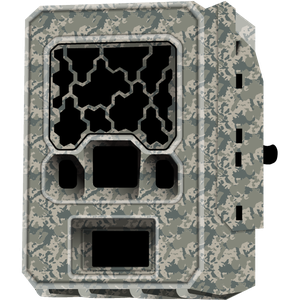
The best way to check for Northern Quolls is by using remote cameras. This is a method where cameras are placed out on Country and left to record any animals that move past the camera. The camera can be lured (usually with food like peanut butter, sardines or apples) to encourage an animal to visit the camera. If a species is detected on camera, its presence is recorded. This method doesn’t focus only on Northern Quolls, as the presence of all species is usually recorded.
If the cameras are set up in the correct way, the data can be analysed to get extra information like population size. This is because each Northern Quoll has its own unique spot pattern on its fur which means it can be individually identified. AI programs are increasingly being used to help identify individual Northern Quolls on camera.
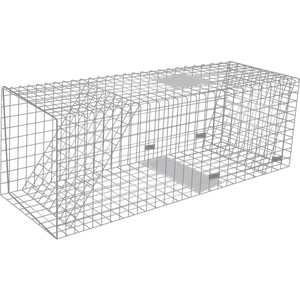
REMEMBER! Live trapping surveys for Northern Quolls should only be undertaken between May and August to avoid trapping females with young in the den.
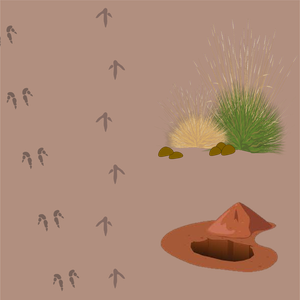
You can also check for Northern Quolls by searching for tracks and scat. This method involves searching a 2 hectare (Ha) area for all signs of animals, including tracks, scats, diggings and other signs like burrows. If signs of a species are found in a plot, its presence is recorded. This method doesn’t focus only on Northern Quolls, as the presence of all species is recorded.
Primary sources
This landing page was developing using the following sources:
Primary sources
This landing page was developing using the following sources:
· Threatened Species Scientific Committee (2005). Commonwealth Listing Advice on Northern Quoll (Dasyurus hallucatus). Commonwealth of Australia. https://www.dcceew.gov.au/environment/biodiversity/threatened/assessments/dasyurus-hallucatus-2005
· Hill, B.M., Ward, S.J. (2010). National Recovery Plan for the Northern Quoll Dasyurus hallucatus. NT Department of Natural Resources, Environment, The Arts and Sport: Darwin, NT. https://www.dcceew.gov.au/sites/default/files/documents/northern-quoll.pdf
· Moore, H.A., Dunlop, J., Jolly, C.J., Kelly, E., Woinarski, J.C.Z., Ritchie, E.G., Burnett, S., van Leeuwen, S., Valentine, L.E., Cowan, M.A., Nimmo, D.G. (2021). A brief history of the northern quoll (Dasyurus hallucatus): a systematic review. Australian Mammalogy 44(2): 185-207. https://www.publish.csiro.au/AM/AM21002
· Moore, H.A., Dunlop, JE., Valentine, L.E., Woinarski, J.C.Z., Ritchie, E.G., Watson, D.M., Nimmo, D.G. (2019). Topographic ruggedness and rainfall mediate geographic range contraction of a threatened marsupial predator. Diversity and Distributions 25(12): 1818-1831. https://onlinelibrary.wiley.com/doi/epdf/10.1111/ddi.12982
· Hernandez-Santin, L., Henderson, M., Molloy, S.W., Dunlop, J.A. & Davis, R.A. (2020) Spatial ecology of an endangered carnivore, the Pilbara northern quoll. Australian Mammalogy 43(2): 235-242. https://doi.org/10.1071/AM19052
· Hernandez-Santin, L., Fisher, D. & Goldisen, A. (2018). Ecology and predator associations of the northern quoll in the Pilbara. Report for the National Environmental Science Program (NESP). Threatened Species Recovery Hub. https://www.nespthreatenedspecies.edu.au/media/zw1gfnxz/northern-quoll-report_lorna_webnew.pdf
· NESP Threatened Species Recovery Hub (2018). Life of quolls in the Pilbara. https://www.nespthreatenedspecies.edu.au/news-and-media/latest-news/life-of-quolls-in-the-pilbara
· Hohnen, R., Ashby, J., Tuft, K., McGregor, H. (2013). Individual identification of northern quolls (Dasyurus hallucatus) using remote cameras. Australian Mammalogy 35:131-135. https://www.publish.csiro.au/am/pdf/AM12015
· Dunlop, J., Moore, H.A., Cowan, M.A., Harrison, N. (2024). Survey techniques and impact mitigation for the Endangered northern quoll (Dasyurus hallucatus) in the semi-arid landscapes of the Pilbara. Australian Mammalogy 46:AM24003. https://www.publish.csiro.au/am/pdf/AM24003
Tools and resources
· Survey recommendations: https://www.dcceew.gov.au/sites/default/files/documents/referral-guideline-northern-quoll.pdf
· Survey techniques: https://www.publish.csiro.au/am/pdf/AM24003 and https://emsa.tern.org.au/document/download/123/b5834edc-f431-4f44-b6a6-6502d2056ee7/117
Tools and resources
- file_save Cage Trapping
- file_save Landscape Camera Traps