Monitoring Country

Cage Traps
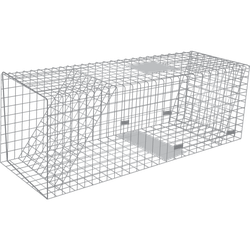
Cage traps are made from wire mesh and have a door that is triggered to shut after an animal enters the trap and steps on the treadle plate. Cage traps are commonly used to capture medium-sized mammals, but they can also capture non-target species like birds and reptiles.
Cage traps are usually baited with food that smells tasty to mammals. The bait is put at the back of the trap so that the animal has to fully enter the trap to reach it. When the animal enters the trap and steps on a treadle plate, its weight triggers the door to shut, trapping it inside.
Cage trapping must involve people who are experienced with trapping, handling and measuring mammals, and proper training and endorsement by a qualified practitioner is essential. Cage trapping also usually needs to have the appropriate scientific licences and animal ethics approvals.

Cage Trap
Why are cage traps useful
Get a close up look: When animals are caught in a cage trap, you can learn more about that particular individual that you can’t learn from less invasive methods like camera monitoring. You can weigh and measure them, check if they are male or female, see how healthy they are and if they are breeding, and collect samples.
Track them over time: You can identify individual animals with technology like microchips. If you do cage trapping at the same place on different occasions over a long time, you can see how individuals and the population change over time.
Get the full picture: While other methods like camera traps, track counts and audio recorders can show you what animals look or sound like or where they live, cage trapping can help you gather more details about an entire population. You can estimate how big the population is, learn about the population health and how they are moving or using Country.
Cage trapping must involve people who are experienced with trapping, handling and measuring mammals. It is a good idea to talk to an experienced professional if you are thinking about running a cage trapping survey – they may be able to give you advice on what species you will expect to catch, what disease or health issues you need to think about, how many traps and nights you will need, what licences and permits you need to apply for, and what training or experience is needed.
Cage traps are invasive, meaning you disturb any captured animal and its daily life. It is also more stressful for the animal than methods that don’t involve capturing and handling the animal, like camera monitoring or spotlighting. You should consider whether there is another method that will cause less disturbance and provide you with the information you need.
REMEMBER! Methods like microchipping and taking genetic samples can be highly invasive and when done poorly can result in severe injury or even death to an animal. Proper training and endorsement by a qualified practitioner is essential.
If you need information that you can only learn from cage trapping, identify ways in which you can minimise the impact on animals, like:
trap for as few nights as possible to get the data you need (
avoid trapping during breeding seasons
avoid trapping in extreme weather (hot or cold)
check traps very early each day or even at night
check traps more frequently through the night
close traps during the day to avoid exposing animals to daytime conditions
close traps if an animal is caught too many nights in a row
close traps if a female with dependent young is caught
handle the animals as little as possible (only collect the data you need)
There are different cage traps available, including collapsible ones that are easier to carry when walking long distances. It is important to use cage traps that have a treadle plate mechanism, and be the right size for the target species:
Large cage traps (approx. 45 cm x 45 cm x 90 cm) are useful for trapping Feral Cats
Small cage traps (approx. 20 cm x 20 cm x 55 cm) are useful for trapping most medium-sized native mammals like Quolls, Bandicoots, Possums and Bettongs.
Cage traps should be safe for animals:
Before setting them up, make sure they are safe by checking that they have nothing inside the trap that might hurt an animal like bait hooks or sharp edges, and that the wire gauge is small enough to prevent animals from getting teeth and/or heads stuck.
When setting them up make sure that they are not near ant nests and that animals are shaded and protected from weather. This usually means putting the trap next to a tree or other vegetation, covering it with a hessian bag and weighing the trap and hessian bag down with a rock or stick. Some species need extra protection, for example, stubby coolers can be used to protect small mammals when temperatures are low.
The type of bait used is based on the type of mammals you are trying to catch. Universal bait (a ball of peanut butter and oats) is used for most mammal surveys, but a different type of bait can be used if you want to trap a specific species. Remember that fish or meat-based lures can attract more ants and reptile by-catch. Some common lures include:
Universal bait: Peanut butter and oats, sometimes with or without other ingredients like tuna oil, sardines or honey - used for general mammal surveys, the additional ingredients can increase the risk of ants which are a welfare issue and therefore should only be used in specific circumstances.
Apple and/or sweet potato: surveys targeting mammals that are mostly herbivorous (eat vegetation) like Wallabies or native rodents
Meat lures like chicken, tuna, sardines or fish oil: can be used to target carnivores (eat meat) like Quolls but they can increase the risk of ants which is a welfare issue and therefore should only be used in specific circumstances.
Cage traps can monitor the small to medium-sized mammals living on Country.
What can you learn?
Using cage traps, you can learn about the different species of mammal living in an area and check on the health of individual animals. By monitoring the same places, over many years, you can see if there are changes in which species live there (biodiversity) and changes in population size and health. You can also learn about where animals live and which types of habitat they are using (occupancy), which can be a simpler way to track changes in a population.
What can’t you learn?
Cage traps aren’t good for monitoring birds, most reptiles, frogs or insects, even though these animals might still go into a cage trap.
Cage traps are also not useful for monitoring some mammals if they are:
too light to set off the trigger, like native mice or other small mammals.
mostly awake during the day, like Numbats
not interested in baits/lures, like Echidnas
too scared to go in the trap, like Banded Hare-wallabies
too big to fit inside the cage trap, like Rock Wallabies
Cage traps shouldn’t be used to monitor mammals that get capture myopathy. Capture myopathy happens when the stress of being caught causes an animal to become sick or die, sometimes even after it has been released. Capture myopathy is common in some species of kangaroo and wallaby. Talk to an expert to find out if the animals you might capture are known to get capture myopathy.
Any time you do work that might disturb or interfere with native animals and vegetation, particularly threatened species, you need to check with the state authorities to see if you need any approvals, such as scientific licences or animal ethics committee permits.
Small-medium mammals can be monitored with cage traps to find out what species are living on Country (inventory), where they are living (occupancy), how many there are (abundance/population size) and how healthy they are.
This document assumes that each trapping team has a team leader who is experienced with trapping, handling and processing mammals. It therefore does not provide instructions for procedures like microchipping, measuring, taking genetic samples, or dealing with ejected pouch young, venomous or dangerous by-catch, or euthanasia. The following website has some additional procedures that may be of use: https://www.dbca.wa.gov.au/science/animal-ethics-and-use-animals
Primary sources
This landing page was developed using the following sources:
DBCA (2024). Standard Operating Procedure SC25-03 Cage traps for capture of terrestrial vertebrates. WA Department of Biodiversity, Conservation and Attractions: Perth, WA.
Department of Sustainability, Environment, Water, Population and Communities (2011). Survey guidelines for Australia’s threatened mammals. Commonwealth of Australia.
DBCA (2024). Animal ethics and the use of animals: ensuring the welfare, safety and health of animals used by DBCA for scientific purposes. Department of Biodiversity, Conservation and Attractions: Perth, WA.
Tools and resources
Codes for the humane capture, handling and destruction of feral animals in Australia
Australian code for the care and use of animals for scientific purposes
EMSA standardised survey methods: Vertebrate Fauna Module