Monitoring Country
eDNA Monitoring
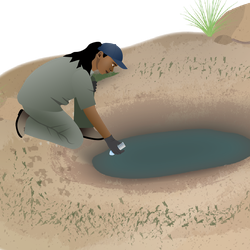
Animals leave genetic (DNA) traces of where they have been shedding their fur, skin, urine, faeces, sperm and eggs into the environment. This DNA can be found for a short time afterward using environmental DNA (eDNA) monitoring. This involves taking a water, soil or air sample and seeing if there is any trace of animals in the sample.
Before eDNA sampling was possible, a person needed to be able to see, hear or catch an animal to confirm that it was on Country. But there are lots of animals that are difficult to detect because there aren’t many of them, they hide away and avoid people (cryptic), they move around, or where they live is hard to get to.
Why is eDNA useful?
Less stress for animals: eDNA sampling doesn’t involve catching, handling or getting close to animals. Animals are often stressed if they are caught and often change their behaviour when people are around.
Find what you miss: eDNA can detect animals that have passed through the area that are difficult to see, hear or catch.
Simple: Collecting eDNA samples doesn’t need specialised training or expensive and complicated equipment. But to get the results of what species have been detected, the samples need to be sent off for genetic analysis and checked by an expert.
Save time: eDNA monitoring can detect lots of different species from one water sample, which means monitoring can be done more often and across a larger area. But the genetic analysis of the samples can take weeks or months.
What can eDNA monitor?
eDNA can monitor the species that are using Country. It is most effective for monitoring aquatic animals like fish and frogs, and terrestrial animals that use water bodies. But eDNA technology is continuing to improve and more animals and plants species are able to be detected from water, soil and air samples.
What can you learn?
eDNA monitoring can be used to detect a single species, like a Threatened animal or an invasive species, or it can be used to detect lots of different species to monitor the biodiversity on Country.
What can’t you learn?
eDNA monitoring can’t be used to estimate the population size or health of a species.
eDNA analysis only works if the species’ DNA barcode or signature is already known and a species must have already had genetic samples collected in another way like trapping. This means eDNA monitoring can’t be used to detect new species or species only known from photos and videos.
Using eDNA the Right-Way
REMEMBER! Any time you do work that might disturb or interfere with native animals and vegetation, particularly threatened species, you need to check with the state authorities to see if you need any approvals, such as scientific licences or animal ethics committee permits.
If eDNA samples are not collected in the right way, the samples can become contaminated leading to ‘false positives’. Best practice includes:
- Use sterile equipment including clean/new gloves and sample tubes
- Clean or use new equipment between different sites
- Wear gloves to avoid touching sampling equipment with bare hands
Avoid mixing up the samples by always clearly labelling them with unique numbers/codes and recording detailed data.
DNA can degrade quickly and become unusable so always preserve (e.g. freeze) samples immediately after collecting.
Gnamma monitoring with eDNA water samples
Gnammas can be monitored with eDNA water samples to find out what animals are using the waterhole.
You can learn more about the using eDNA water samples to monitor gnammas on the Things we Care About page, in the Standard Operating Procedure for Gnamma Monitoring and by watching this instructional video.
Predator monitoring with eDNA scat samples
Feral predators can be monitoring by collecting scat samples to find out if the scat belongs to a native or feral predator, and what species the animal has been eating.
You can learn more about using eDNA scat samples to monitor predators by watching this instructional video.
Frog monitoring with eDNA water samples
Frog biodiversity or a specific species of frog can be monitored with eDNA water samples to detect if they are or have recently been in a waterbody.
You can learn more about using eDNA water samples to monitor frogs on the Things We Care Aboutpage and in the Standard Operating Procedure for eDNA Water Sampling (EnviroDNA Kit) or Standard Operating Procedure for eDNA Water Sampling (no kit)
Cane Toad monitoring with eDNA water samples
Cane Toads can be monitored with eDNA water samples to detect if they are or have recently been in a waterbody.
You can learn more about using eDNA water samples to monitor Can Toads on the Things We Worry About page and in the Standard Operating Procedure for eDNA Water Sampling (EnviroDNA Kit) or Standard Operating Procedure for eDNA Water Sampling (no kit)
Gouldian Finch monitoring with eDNA water samples
Gouldian Finches can be monitored with eDNA water samples to detect if they are or have recently been in a waterbody.
You can learn more about using eDNA water samples to monitor Gouldian Finches on the Things We Care About page and in the Standard Operating Procedure for eDNA Water Sampling (EnviroDNA Kit) or Standard Operating Procedure for eDNA Water Sampling (no kit)
Platypus monitoring with eDNA water samples
Platypus can be monitored with eDNA water samples to detect if they are or have recently been in a waterbody.
You can learn more about using eDNA water samples to monitor Platypus on the Things We Care About page and in the Standard Operating Procedure for eDNA Water Sampling (EnviroDNA Kit) or Standard Operating Procedure for eDNA Water Sampling (no kit)
Primary sources
This landing page was developed using the following sources:
Primary sources
This landing page was developed using the following sources:
- DeBrauwer, M., Clarke, L.J., Chariton, A., Cooper, M.K., de Bruyn, M., Furlan, E., MacDonald, A.J., Rourke, M.L., Sherman, C.D.H., Suter, L., Villacorta-Rath, C., Zaiko, A., Trujillo-Gonzalex, A., (2022). Best practice guidelines for environmental DNA biomonitoring in Australia and New Zealand. Environmental DNA 5:417-423. https://research-management.mq.edu.au/ws/portalfiles/portal/297635415/224363642.pdf
- Berry, O., Jarmin, S., Bussett, A., Hope, M., Paeper, C., Bessey, C., Schwarts, M.K., Hale, J., Bunce, M. (2020). Making environmental DNA (eDNA) biodiversity records globally accessible. Environmental DNA 3(4): 699-705. https://onlinelibrary.wiley.com/doi/10.1002/edn3.173
- Villacorta-Rath, C., Burrows, D. (2021). Standard operating procedure for environmental DNA field sample collection (Report 21/49). James Cook University Centre for Tropical Water and Aquatic Ecosystem Research (TropWater): Townsville, QLD. https://nesplandscapes.edu.au/wp-content/uploads/2021/11/SOP-for-eDNA-field-sample-collection-report.pdf
- De Brauwer, M., Berry, O. (2023). It sounds like science fiction. But we can now sample water to find the DNA of every species living there. The Conversation. https://theconversation.com/it-sounds-like-science-fiction-but-we-can-now-sample-water-to-find-the-dna-of-every-species-living-there-216989
- CSIRO (2024). eDNA biomonitoring. https://research.csiro.au/teamcoast/environmental-dna/
- Northern Australia Environmental Resources Hub (2018). Start-up Factsheet: Developing eDNA methods to detect Top End Animals. NESP. https://nesplandscapes.edu.au/wp-content/uploads/2018/08/Terrestrial-eDNA-start-up-factsheet.pdf
Tools and resources
- Australia/New Zealand eDNA best practice guidelines: https://research.csiro.au/environomics/australia-new-zealand-edna-best-practice-guidelines/