Monitoring Country

Autonomous Recording Units (ARUs)
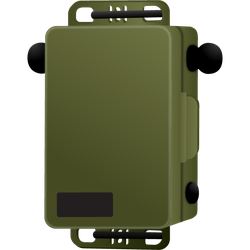
ARUs are a useful tool for monitoring animals that make calls or songs, such as frogs and birds. They are a sound recording device that can be set to record the sounds of Country over time and save them to a memory card.
Before using ARUs to monitor animal calls, a person needed to be at the location to listen for calls. The presence of the person monitoring might change the behaviour of the animals, which could mean that the data might not be showing the true story. Monitoring calls this way also needs each call to be identified as they are heard, and you usually can’t re-listen to a call, or ask somebody else to check identifications you make.
ARUs can record the calls for you, with the benefit of causing less disturbance to the animals you want to learn about. You can set the ARUs to start recording any time a call is made, or to record at specific times. For example, at night for bats, or after sunset and before sunrise for night parrots. Then, you can check the sound recordings using computer software to see which species’ calls have been captured. By using specialised software, species can be identified by looking at or listening to the recorded calls. By having a permanent record of the calls, experts can be asked to check identifications.
Why are ARUs helpful?
Less stress for animals: Animals often change their behaviour when people are around.
Hear what we miss: ARUs can record all day and night, recording sounds made by animals that don’t call much or those that call when we're not around.
Do the time for you: ARUs can capture data for long periods of time, requiring less time on Country. Monitoring over longer periods of time can increase the likelihood of picking up rare or infrequently calling species. But they can need lots of time in the office to manage and analyse data.
Listen again later: Unlike relying on memory, ARUs save all their recordings. We can listen back later and use special computer programs to figure out which animals made the sounds.
What can we learn using ARUs to monitor?
ARUs can monitor the species calling on Country. Using ARUs, we can learn how many different (calling) species live in a place. We can tell if species we are interested in are living in or using a place, such as a water hole, and when they are using it. By monitoring the same places, over many years, we can see if there are changes to the species that live there.
What can’t ARUs tell us?
What ARUs can’t tell us is how many animals there are, as the number of calls doesn’t always tell us how many animals there are.
We also can’t assume that because we don’t hear a species calling, they are not there.
When using ARUs, you should consider what you are trying to monitor and what your aims are. This should guide where and how you set them up.
Using ARUs the Right-way
A LOT of data! An important consideration when using ARUs is that they produce a large amount of data. Storing and managing data well is important to:
- Make sure it is organised so that people can find data when they need to.
- Data doesn’t get lost or corrupted; and if this happens, recovery is possible, or back-ups are available.
The way we use ARUs to monitor should be tailored to what we are trying to monitor. Below, we give you some tips for general monitoring of birds, bats and frogs, then provide some guidance on what you need to consider when targeting a species of interest.
Bird monitoring with ARUs
Birds can be monitored by using ARUs to record their calls. When setting up ARUs aiming to monitor birds, these are some things you should consider:
- Timing – monitor during times when present and calling.
- Think about seasonal changes. For example, migratory birds travel to feeding sites at certain times of year, if monitoring at these sites you would aim to
- Think about when birds are most active. Most birds are usually active during the day, with the most activity (and calling) around sunrise and sunset. However, if you are aiming to learn about nocturnal birds, then you would program ARUs to record at night.
- If you are unsure when to record, you can set ARUs to record for a short period of time, periodically throughout the day.
- Location – if interested in monitoring all possible bird species, place recorders in as many habitats that birds may be using as possible.
- Mount recorders on something sturdy 1 – 2 metres from the ground, avoiding things that might brush against the recorder (e.g. leaves or branches). Place recorders at least 250 m apart to avoid “double counting”.
For a Standard Operating Procedure on how to monitor with ARUs, click here.
Microbat monitoring with ARUs
Microbats (bats) can be monitored by using ARUs to record their calls. Bats use ultrasonic, or high frequency, calls to navigate and hunt but humans can’t hear most of these calls. Specialised ARUs with high-frequency microphones can pick up and record calls within the range that bats make them. When setting up ARUs aiming to monitor bats, these are some things you should consider:
- Habitat – choose a location where there will be bat activity, such as roosting (sleeping) sites, foraging (feeding) areas or water sources. Monitoring in places where bats are more likely to be will make it more likely that you will record them if they live there.
- Make sure that the ARU microphone is not aimed towards a solid surface like a big tree or rock face. Bat calls bounce off surfaces like this, so an ARU microphone aimed towards one might produce bad data by recording double or mixed up calls that are hard to identify.
Caption: Bat call made visible as images by computer software.
Each bat species has unique calls, so the recordings can be analysed using specialised software that makes the calls visible as pictures, called spectrograms. By looking at the spectrograms, you can identify which bat species made the recorded calls. This method allows you to monitor the bat species that live in a place, telling you which bat species are present (species richness).
For a Standard Operating Procedure on how to monitor bat with ARUs, click here.
Frog monitoring with ARUs
Frogs can be monitored by using ARUs to record their calls. When setting up ARUs aiming to monitor frogs, these are some things you should consider:
- Timing
- Deploy ARUs at times when frogs will be calling, such as after a good rain, or during breeding season.
- Program ARUs to tell you what you want to know. Do you want to target species or do general monitoring? e.g. record at times of day when the species of interest will be calling, if you don’t know what times they will call, or if you want to know about all species, you can program to call for short periods of time distributed throughout the day.
- Location – choose sites that suit frog biology and habitat.
For a Standard Operating Procedure on how to monitor with ARUs, click here.
I want to monitor a particular species
ARUs can be used to monitor a single species that we are interested in learning more about. To learn if they live (or don’t live) in a place, we can set up recorders in ways that increase our chance of detecting the species and target their preferred habitat.
How to target species with ARUs:
- Learn about the species to help guide your monitoring.
- Where does it like to live? This can help you decide where to put the ARU.
- When does it usually call – time of year, time of day, after lots of rain, during breeding season?
- Do you know about the calls it makes? If you know what frequency range it falls within, you can program the ARU to record only calls that fall within this range.
List of all assets/threats that can be monitored with ARUs
Soundscapes
There is work being done to understand what healthy Country sounds like. This is called “Soundscapes”. If you would like to use this method, we recommend that you talk to an expert. You can talk to a soundscapes researcher, by emailing: researcher@uni.edu.au
Buying guide
Some examples of software you could use to analyse acoustic data:
Kaleidoscope:
Free version with spectrogram viewer that allows you to listen to, view and label audio recordings.
Paid version with more functions.
https://www.wildlifeacoustics.com/products/kaleidoscope
Raven:
Free version that lets users record, save, and visualize sounds as spectrograms and waveforms.
Paid version with more functions.
https://www.ravensoundsoftware.com/software/
WarbleR:
Open source where users can collect open-access avian recordings or enter their own data into a workflow that facilitates spectrographic visualization and measurement of acoustic parameters.
https://github.com/maRce10/warbleR
Arbimon
Free online ecoacoustic analysis platform empowering scientists and conservationists with a way to upload, store, and analyse acoustic data, enabling the ability to derive insights about the ecosystem at scale.
Online libraries of wildlife sounds:
Xeno-canto:
Online collection of wildlife sound recordings.
eBird:
Online collection of bird sound recordings.
Link to general ARU SOPs
Link to ARU buying guide
Link to bat (?) ARU SOPs
Link to general ARU SOPs